
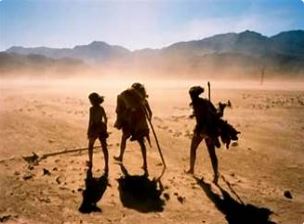
Survival of the friendliest? Why Homo sapiens outlived other humans
We once shared the planet with at least seven other types of human. Ironically, our success may have been due to our deepest vulnerability: being dependent on others
24 November 2021
ESLeer en Español
Simon Pemberton
HUMANS today are uniquely alone. For the majority of the existence of Homo sapiens, we shared the planet with many other types of human. At the time when our lineage first evolved in Africa some 300,000 years ago, there were at least five others. And if you were going to place a bet on which of those would outlast all the rest, you might not have put your money on us.
The odds would have seemed more favourable for the Neanderthals, who had already adapted to live in colder conditions and expanded to inhabit much of Eurasia. Or Homo erectus, who had made a success of living in south-east Asia. By contrast, our direct Homo sapiens ancestors were the new kids on the block, and wouldn’t successfully settle outside of Africa until more than 200,000 years later. Yet, by 40,000 years ago, or possibly a bit more recently, we were the only humans left standing. Why?

Many explanations have been put forward: brainpower, language or just luck. Now, a new idea is building momentum to explain our dominance. Ironically, it may be some of our seemingly deepest vulnerabilities – being dependent on others, feeling compassion and experiencing empathy – that could have given us the edge. Today, surrounded by computers, phones and all the other clever things we have invented, it is easy to pin our success on our cognitive abilities. But the more we learn about other types of human, the more they seem similar to us in this regard. In the case of Neanderthals, and possibly the mysterious Denisovans, this includes the ability to make sophisticated tools, such as projectile spears that enabled them to hunt large game. Similarly, we are discovering that artistic flair – a marker for the ability to think symbolically, and thought to be another vital ingredient for our dominance – wasn’t just the preserve of our species. Homo erectus etched patterns onto shells some 500,000 years ago and Neanderthals drew on cave wall
More recently, the focus has shifted from intelligence to our ability to network with strangers: the survival of the friendliest. Archaeological evidence shows, for example, that Homo sapiens not only lived in larger groups than all other humans, but had an unparalleled ability to form alliances beyond their immediate group. It might be that these social abilities helped to make us the most adaptable humans, the only ones capable of occupying every single biome on the planet.

Other humans certainly became adept at living in particular environments. Homo heidelbergensis and the Neanderthals, for example, had the cultural and technological skills – the ability to make clothing, fire and shelter – needed to branch out into colder climes. The diminutive newly discovered Homo luzonensis, along with Homo floresiensis (aka the hobbit), thrived in woodland environments. “But it is doubtful that these humans would have been successful if they were magically plopped down in the other’s habitat, whereas sapiens likely could have,” says Brian Stewart, an archaeologist at the University of Michigan.
Stewart, together with Patrick Roberts, an archaeologist at the Max Planck Institute for the Science of Human History in Jena, Germany, argues that our Homo sapiens ancestors set themselves apart by developing a new ecological niche, which they call the generalist specialist. “Not only could Homo sapiens generalise and expand across the world, but specific populations could also specialise in certain environments,” says Roberts. “Together, this allowed our ancestors to thrive in the face of climatic and environmental variability.”
- Take our expert-led evolution course and explore the source of life’s diversity
However, it still isn’t clear how we became the masters of adaptability. Now, Penny Spikins, an archaeologist at the University of York, UK, has a new explanation. She thinks that our emotional nature and frailties gave us the edge. “Our emotional neediness gave us the drive to connect with others,” she says. And expanding our network made us more resilient, allowing us to flourish in many different environments.
To understand why, we have to turn the clock back around 2 million years to when these complex emotions appear to have emerged, and travel to southern Africa to meet our ape-like ancestor Australopithecus. Here, we find the earliest known examples of the possible care for sick or injured hominins, with evidence from the skeletons of individuals who lived with bone problems that would have caused pain and disability, such as a teenage boy with a spinal tumour. “They almost certainly received some level of help, being given food and protection, to survive with these conditions,” says Spikins, whose book read more…
